Why are we doing this research?
Interwoven creates experiences using sound, light, movement, colour, space and interaction.
That means the sensory environment matters.
We do not want to make design decisions simply because something looks inclusive, feels right to us, or follows a trend. We want to understand what published research, accessibility guidance, lived experience and real-world practice can tell us about what helps people take part — and what can become a barrier.
We collect that knowledge here for two reasons:
- to make better Interwoven experiences, and
- to share useful evidence openly, so other people creating public spaces and experiences can learn from it too.
Sensory-considered design
By sensory-considered, we mean thinking deliberately about how sound, light, movement, space, pace and interaction work together from the beginning.
It does not mean making everything quieter, dimmer or less stimulating.
It means asking better questions:
- What might this sound feel like to different people?
- Can someone choose whether and how to engage?
- Are they rushed?
- Can they move away and return?
- Do they know what is going to happen?
- Is there more than one meaningful way to participate?
Good sensory-considered design is not about removing experience. It is about removing unnecessary barriers to it.
A simple example: sound
What if a sound that feels ordinary to one person feels overwhelming to another?
A 2021 meta-analysis brought together data from more than 13,000 autistic people. Using interview and questionnaire measures, it estimated that around 41% experienced current hyperacusis and around 61% had experienced it at some point in their lives.
Hyperacusis means reduced tolerance to sounds that would not usually trouble most people. The wider research also shows that sensory experience varies considerably between individuals: people may be more sensitive to some inputs, less sensitive to others, or seek particular kinds of sensory stimulation.
What does that mean for Interwoven?
If we are creating musical experiences, volume cannot be an afterthought.
We need to think about:
- how loud individual instruments are;
- the character and tone of the sound;
- what happens when several sounds combine;
- how far sound travels;
- background noise;
- whether somebody can control their distance from it;
- whether quieter areas remain available.
That does not mean making every experience silent.
It means recognising that more volume does not automatically create more impact.
Explore the research
The research below is organised by the design question, rather than by diagnosis.
The same evidence may be relevant to autistic people, disabled people, sensory-sensitive visitors and many other people who simply experience environments differently.
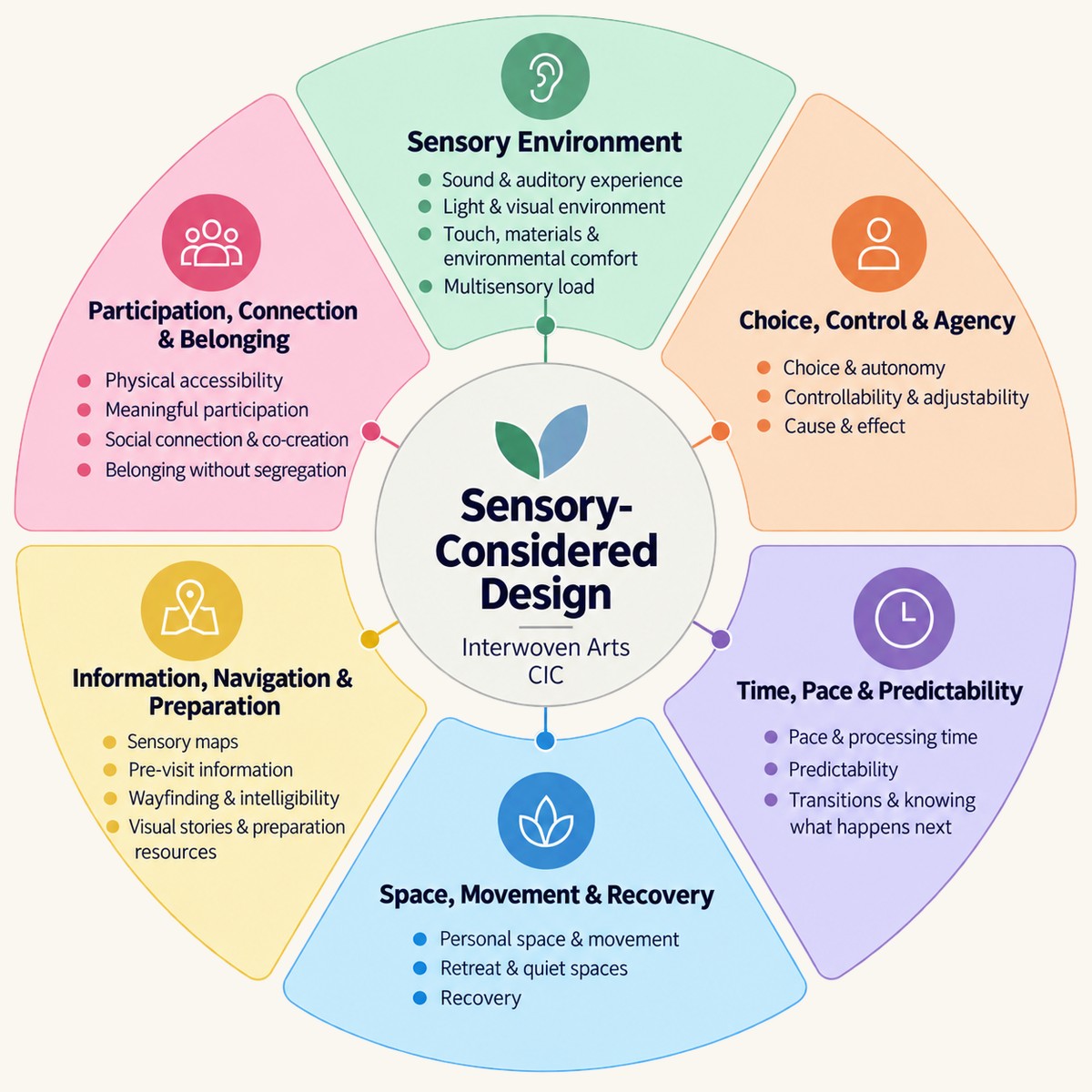
1. Sensory Environment
The sensory environment is the combination of what we hear, see, feel and experience around us.
A 2026 scoping review of 77 studies on sensory stimuli in the built environment identified four major sensory modalities — visual, auditory, tactile and olfactory — alongside factors including lighting, colour, visual complexity, materials, thermal conditions, acoustics, sound sources, spatial configuration, wayfinding and natural elements.
The important point is that the sensory environment is not one thing.
Sound & auditory experience
Research uses terms including:
- hyperacusis — reduced tolerance to sounds that would not trouble most people;
- decreased sound tolerance — a broader umbrella covering different difficulties with sound;
- background noise;
- auditory filtering;
- acoustic environment;
- reverberation;
- sound-source characteristics.
For Interwoven, the design questions include:
How loud is it? What does it sound like? What happens when several sounds occur together? Can someone control their distance from the sound? Is there somewhere quieter to move to?
Research anchors
- Williams, Z. J., et al. (2021), Prevalence of Decreased Sound Tolerance (Hyperacusis) in Individuals with Autism Spectrum Disorder: A Meta-analysis
- National Autistic Society, Autism and sensory processing
- Wang, Z., et al. (2026), Sensory stimuli in the built environment for autistic people: A scoping review
Light & visual environment
Visual experience is more than simply whether a space is bright or dark.
Research and guidance repeatedly discuss:
- brightness;
- glare;
- flicker;
- fluorescent lighting;
- colour;
- contrast;
- visual clutter;
- visual complexity.
The evidence does not give one universal lighting level that will suit everybody.
For Interwoven, the better questions are:
Is this lighting unnecessarily harsh? Is there flicker or glare? Are several visual effects competing at once? Can someone choose where to look or move away from a more intense area?
Touch, materials & environmental comfort
Sensory experience also includes what the body encounters physically.
Relevant research language includes:
- tactile experience;
- material qualities;
- texture;
- thermal conditions;
- temperature;
- physical comfort.
For Interwoven, that means thinking beyond sound and light.
What does something feel like to touch? Does it vibrate? How much force does it require? Is it comfortable to reach? What happens in heat, cold, wind or rain?
Not every factor can be controlled outdoors, but it can still be considered.
Multisensory load
People rarely experience sound, light, movement and space one at a time.
Research into multisensory integration examines how information from different senses is combined. A systematic review and meta-analysis found group differences in audiovisual multisensory integration between autistic and non-autistic participants, while also finding substantial variation across studies.
The 2026 built-environment review also identified a research gap: relatively few studies examine how multiple sensory modalities work together in real environments.
What does that mean for Interwoven?
We should not assess every sensory feature in isolation.
A sound may be comfortable on its own.
A light may be comfortable on its own.
Movement may be comfortable on its own.
But several intense things happening together may create a very different experience.
Interwoven sometimes uses the internal design idea sensory coherence to ask whether sound, light, movement, space and pace are supporting one another rather than competing unnecessarily.
Sensory coherence is an Interwoven design concept, not an established clinical term.
2. Choice, Control & Agency
Accessibility is not always about reducing stimulation.
Sometimes it is about giving somebody more control over how they experience it.
The built-environment literature repeatedly identifies choice, adjustability, predictability and controllability as important design qualities.
Choice & autonomy
Choice is having meaningful options.
Autonomy is being able to decide whether, when and how to participate.
Research with autistic adults with intellectual disabilities has highlighted choice and control as central to how participants wanted their autonomy supported.
For Interwoven, autonomy can mean:
- choosing whether to take part;
- choosing what to interact with;
- choosing how close to get;
- choosing when to stop;
- watching before joining;
- stepping away;
- returning later.
Participation should be invited, not forced.
Controllability & adjustability
A 2026 review identified adjustability and controllability among six qualities of sensory-inclusive built environments.
Control can be environmental — for example, being able to move further away from a sound.
It can also be interactive — when an action produces a clear, understandable response.
For Interwoven, this means asking:
Can the person change their relationship with the experience rather than simply enduring whatever we give them?
Cause & effect
Cause and effect is central to many Interwoven interactions.
A person acts.
Something changes.
They can understand that their action mattered.
That relationship can strengthen agency because the participant is not simply receiving sensory input — they are influencing it.
For Interwoven, good interaction should make it possible to discover:
I did that. If I change what I do, something else happens.
This is a design principle informed by the wider research on controllability and agency rather than a claim that one specific type of cause-and-effect interaction produces a guaranteed developmental outcome.
3. Time, Pace & Predictability
The sensory experience is not only what happens.
It is also when, how quickly and how unexpectedly it happens.
Pace & processing time
Some experiences rush people through a fixed sequence.
Interwoven wants to consider whether somebody has enough time to:
- notice;
- process;
- decide;
- interact;
- repeat;
- pause;
- return.
The research base is stronger around predictability, transitions, choice and control than around one universal rule for “correct pace”.
So Interwoven treats pace as a design question rather than claiming a clinically established speed that works for everyone.
Does the experience give people time to participate on their own terms, or does its pace become another barrier?
Predictability
Predictability appears repeatedly in research on autism and the built environment.
A 2021 scoping review identified three overarching design considerations: sensory quality, intelligibility and predictability.
Predictability does not mean an experience cannot contain surprise or discovery.
It means avoiding unnecessary uncertainty that prevents someone from feeling able to participate.
For Interwoven, useful questions include:
Will I know what happens if I touch this? Can I see where I am going? Is an intense sound going to appear without warning? Can I understand the basic rules of the space?
Transitions & knowing what happens next
Moving from one environment, activity or sensory condition to another can matter as much as the individual areas themselves.
Clear transitions, understandable routes and preparation can reduce the amount of uncertainty a visitor has to manage.
For Interwoven, that can mean thinking about:
- how one part of an experience leads into another;
- whether sensory intensity changes suddenly;
- whether exits and quieter areas are obvious;
- whether somebody knows what happens next.
This overlaps naturally with our work on pre-visit information and navigation.
4. Space, Movement & Recovery
Where somebody can move — and where they can go when they need less — matters.
Personal space & movement
Built-environment research discusses:
- circulation;
- proxemics;
- personal space;
- spatial configuration;
- opportunities to choose different levels of social and sensory interaction.
For Interwoven, movement should not automatically be treated as a distraction from participation.
Someone may need to:
- move between elements;
- stand further away;
- observe from the edge;
- walk while listening;
- leave and return.
Meaningful participation does not require everybody to remain in the same place.
Retreat & quiet spaces
Quiet spaces and opportunities to retreat appear repeatedly in accessibility guidance and built-environment research.
The point is not to isolate somebody.
It is to ensure that engaging with an experience does not become an all-or-nothing decision.
A person can take part, move somewhere quieter and then decide whether to return.
For Interwoven, that means asking:
Is there somewhere to step back without having to abandon the whole experience?
Recovery
The 2026 sensory-inclusive built-environment review identifies recovery as one of six important design qualities.
That is useful language.
Good accessibility does not necessarily mean preventing every difficult sensory moment.
It can also mean making it easier for someone to recover, regulate their own distance and decide what to do next.
For Interwoven this reinforces the value of:
- space;
- pauses;
- quieter areas;
- movement;
- choice;
- re-entry.
5. Information, Navigation & Preparation
Accessibility can begin before somebody arrives.
Knowing what to expect can change whether someone feels able to visit at all.
Sensory maps
Historic England identifies sensory maps as a best-practice accessibility tool for heritage sites.
Its guidance recommends identifying things such as:
- quiet and noisy areas;
- low, bright, flashing or flickering light;
- crowded areas;
- temperature changes;
- strong smells;
- tactile exhibits;
- toilets;
- accessibility support.
This allows visitors to make informed decisions about their own experience rather than the venue deciding what they should be able to tolerate.
What does that mean for Interwoven?
Future public experiences could provide clear sensory information about:
- louder and quieter areas;
- interactive elements;
- lighting;
- routes;
- opportunities to step away;
- physical access;
- what is optional.
Pre-visit information
A 2024 museum study explored pre-visit materials with 22 parents and care partners of autistic children attending a low-sensory museum event.
The materials included a social story, accessibility map and communication book. All participants reported finding the pre-visit materials useful before and during the visit, while also suggesting ways they could be improved.
This is small-scale evidence, not proof that one format works for everyone.
But it supports a straightforward idea:
Knowing more before arrival can make participation easier.
Wayfinding & intelligibility
A space can be physically accessible and still be difficult to understand.
Research uses terms such as:
- intelligibility;
- orientation;
- simple spatial layout;
- visual supports;
- clear circulation;
- wayfinding.
For Interwoven, that means asking:
Can somebody understand where they are, where they can go, and how to leave or find a quieter area without unnecessary confusion?
Visual stories & preparation resources
Museums and heritage organisations increasingly use:
- visual stories;
- social narratives;
- sensory maps;
- quiet-time information;
- photographs of the venue;
- information about what will happen.
A 2025 study of Museums Victoria describes co-designed initiatives including sensory maps, social narratives, quiet times, low-sensory sessions, sensory bags and autism-friendly design changes.
The important principle is not that every Interwoven experience needs every tool.
It is that preparation itself can be part of accessibility.
6. Participation, Connection & Belonging
Interwoven is interested in more than whether somebody can physically enter a space.
The deeper question is:
Can they meaningfully take part?
Physical accessibility
Physical access remains fundamental.
Depending on the experience, this can include:
- routes;
- space around equipment;
- reach;
- seated participation;
- different movement ranges;
- adapted controls or interfaces.
In Great Britain, service providers also have an anticipatory duty under the Equality Act 2010 to consider barriers disabled people may face and make reasonable adjustments where required.
Interwoven should contribute to accessible experiences, but no single installation or activity can make a whole venue legally compliant by itself.
Meaningful participation
Interwoven distinguishes between:
- Access — I can enter.
- Participation — I can join in.
- Contribution — what I do matters.
- Belonging — this experience includes me as part of it.
The 2026 sensory-inclusive built-environment review frames good design in terms of physical, psychological and social wellbeing, rather than sensory comfort alone.
That supports a wider question:
Are we merely reducing discomfort, or are we creating conditions in which somebody can actually contribute?
Social connection & co-creation
Interwoven experiences are often designed so that one person’s action can become something another person responds to.
That can create:
- shared music;
- turn-taking without formal instruction;
- parallel play;
- creative response;
- interaction between strangers;
- communication without relying entirely on speech.
We should treat connection as an opportunity, not an automatic outcome.
But creating alongside somebody else can offer a different route into social participation than simply asking people to talk.
Belonging without segregation
Accessible experiences are sometimes provided as separate sessions or specialist versions.
Those can be valuable and sometimes necessary.
But Interwoven’s wider ambition is to design shared experiences in which different abilities, sensory preferences and ways of participating can coexist.
That means accessibility does not always have to result in separation.
The aim is:
different people, taking part differently, within the same meaningful experience.
This is an Interwoven design principle rather than a claim that shared provision will always be appropriate for every person or context.
Positive Case-Studies
Here is a list of companies, events or installations that are already working in the ways that we are proposing. Each one is a case study for our research.
Vivid Sydney A very large outdoor light festival held across Sydney, Australia, each winter.
Eight things they do, most costing very little.
They publish a list of the fifteen quietest, least intense light works, by name — so a family can plan a route at home before they set off, avoiding the loud, bright parts.
They put warning signs on the intense works themselves, at the entrance, so the decision gets made at the moment it matters.
Three quiet spaces, each staffed — somewhere to sit when it becomes too much, without having to give up and go home.
A “visual story” — a picture-by-picture guide showing exactly what you will see, hear and walk through before you arrive, so nothing is a surprise. Made with Autism Spectrum Australia, an autism charity, and published as a document and as audio.
A communication board — a board of pictures and symbols, so someone who doesn't speak, or doesn't speak English, can point at what they need instead of having to find words.
A QR code at every work giving a spoken description of what's in front of you, for people who can't see it. And a named accessibility contact with a mobile number you can actually ring.
Why it matters to us: nearly every item does the same job — it removes a decision a visitor would otherwise have to make in the dark, in a crowd, with no information, while already overwhelmed. That is exactly the problem an outdoor light installation has to solve, and Vivid solved most of it with signs, lists and a phone number.
RHS Glow, Wisley A winter light trail through the Royal Horticultural Society's gardens at Wisley.
Two things: a published sensory guide, and a published capacity figure.
A seventeen-page guide to what the trail does to your senses — zone by zone. This bit is loud, this bit flashes, this bit is calm. It shows you routes around the parts you would rather avoid.
And a number nobody else publishes. On their quieter sessions they let 400 people an hour through. On a normal session, 1,600 an hour. A quiet session is a quarter as busy — and they have said so in writing.
Why it matters to us: that turns a vague promise into something a venue can plan. “It'll be quieter” is a hope. “A quarter of the usual number of people” is a decision someone made, costed, and can repeat. When we work out how many people can be in our own spaces at once, that is where we start.
The Enchanted Forest, Pitlochry A large light and sound show staged in woodland in Perthshire for several weeks each autumn.
They offer a calmer experience every single night, not on a handful of dates.
Most places that offer a quieter version run it on two or three set dates in a whole season. If you can't make those dates, you don't get it.
The Enchanted Forest keeps the first showing of every evening for autistic visitors, with fewer tickets sold. It isn't a separate event on a separate day — it's the first slot of the normal run, every night they're open. The change costs them almost nothing.
Their communication boards were made with NHS Tayside, the local health service — designed with people who work with autistic children.
In July 2026 they were shortlisted for the VisitScotland Inclusion Award.
Why it matters to us: it is proof that a real, ticket-selling attraction can offer a calmer experience every night rather than four times a season and stay in business. That is the model we are designing towards — not a special event you have to be free on a Tuesday for, but something built into how the place works.
Architects of Air Walk-in inflatable sculptures full of coloured light, touring worldwide since 1992.
The work is calm by default. There is no separate calm version.
Their own description: a space “somewhere between a womb and a cathedral”, which is “simultaneously providing a stimulating and calming environment, compelling many to rest, meander, or meditate.” They say they are “passionate and skilled in creating a safe and nurturing environment for whoever enters”.
More than three million visitors in over forty countries since 1992.
Why it matters to us: the calm is a property of the work itself, not a session in the timetable. Thirty-four years and forty countries with the same structure.
Titanic Belfast & Dublin Zoo's Wild Lights A museum and a winter light trail, both of which prepare you before you arrive.
Both publish a “social story” — the same idea as Vivid's visual story. A picture guide showing what will happen, in order, before you go.
Why it matters to us: these are cheap to make and they remove most of the fear of a first visit. There are almost none of them in the UK.
Published Guidance
The ASPECTSS Design Index, by Professor Magda Mostafa, sets out seven things to get right when designing a space for autistic people. Three apply directly to an outdoor trail: group the space into calmer and busier zones; make the change from one zone to the next gradual rather than sudden; and always provide somewhere to escape to.
The Sensory Trust publishes a free library on designing gardens and trails for people with different sensory needs — how to survey a site, how to write an honest description of what a visitor will meet, and how to use picture-and-symbol systems for people who don't read text.
The Outdoor Accessibility Guidance, from the Sensory Trust with Paths for All, gives measurements you can build to: paths at least 1.2 metres wide, slopes no steeper than one metre of rise over twenty metres of length, and a bench every 100 metres on the most accessible routes.
Why it matters to us: these turn “accessible” from a good intention into numbers a contractor can work from.
Reference list
- Wang, Z., Herman, S. S., Mansor, N. & Yan, S. (2026). Sensory stimuli in the built environment for autistic people: A scoping review. Building and Environment, 292, 114271.
www.sciencedirect.com - Williams, Z. J., Suzman, E. & Woynaroski, T. G. (2021). Prevalence of Decreased Sound Tolerance (Hyperacusis) in Individuals with Autism Spectrum Disorder: A Meta-analysis. Ear and Hearing, 42(5), 1137–1150.
pmc.ncbi.nlm.nih.gov - Talu, V., et al. (2021). Built Environment Design and People with Autism Spectrum Disorder (ASD): A Scoping Review. International Journal of Environmental Research and Public Health, 18(6), 3203.
pmc.ncbi.nlm.nih.gov - Feldman, J. I., et al. (2018). Audiovisual Multisensory Integration in Individuals with Autism Spectrum Disorder: A Systematic Review and Meta-Analysis. Neuroscience & Biobehavioral Reviews, 95, 220–234.
pmc.ncbi.nlm.nih.gov - National Autistic Society. Autism and sensory processing.
www.autism.org.uk - Historic England. How Do We Produce a Sensory Map for Potential Visitors?
historicengland.org.uk - Fortuna, J. K., Chamberlain, E., Filice, L., Kurt, M., Porter, T., Twichell, S. & Ogren, S. (2024). Exploring the Usefulness of Pre-Visit Materials for Children with Autism at a Public Museum. Translational Science in Occupation, 1(1).
digitalcommons.unmc.edu - Frawley, P., et al. (2025). Co-designing autism-friendly museums: insights from autistic individuals and museum professionals. Disability & Society.
www.tandfonline.com - Being able to be myself: Understanding autonomy and autonomy-support from the perspectives of autistic adults with intellectual disabilities.
pmc.ncbi.nlm.nih.gov - Equality and Human Rights Commission / GOV.UK. Equality Act 2010 Code of Practice for services, public functions and associations, 2026.
www.gov.uk
Explore further
Want to know more about a particular topic, study or design decision? Ask Interwoven about sound sensitivity, lighting, sensory maps, accessibility, autonomy, pace, quiet spaces, participation or any of the research collected here.